
Here’s What the Data Actually Says
Let’s get straight to the uncomfortable question every HR manager in Malaysia, Singapore, and Australia is quietly sitting with: Is artificial intelligence coming for my job? The honest answer is nuanced and far more empowering than the headlines suggest.
The 38% Shift You Cannot Afford to Ignore
Gartner’s 2025 research projects that, by 2027, AI will assist in 38% of transactional HR tasks, from screening CVs and scheduling interviews to generating performance summaries. That is not a distant threat. That is the next 24 months.
What this means in practice: if your value proposition as an HR professional is rooted primarily in process execution, running the annual review cycle, managing compliance checklists, or maintaining HRIS (Human Resources Information System) data, your role is genuinely at risk of being de-scoped. Not eliminated. De-scoped. Compressed. Deprioritised.
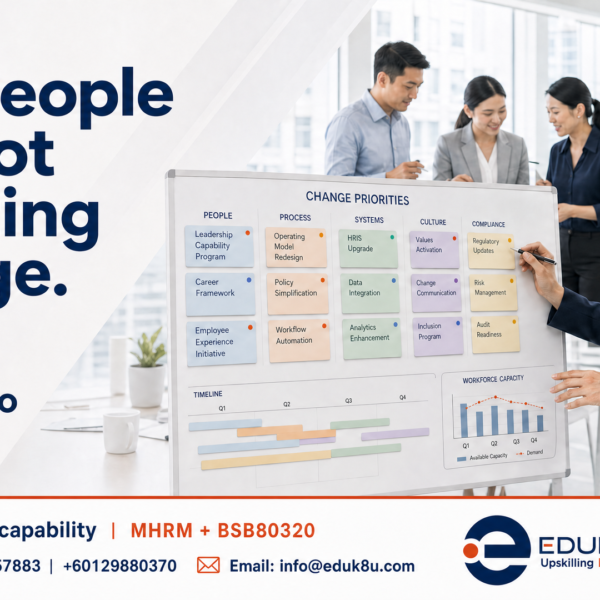
The HR leaders who will thrive are those who have already positioned themselves as workplace intelligence advisers, strategic talent architects, and organisational performance partners. That transition requires more than intent. It requires credentials and capabilities that board members and executive teams recognise.
AI is not making strategic HR leaders obsolete. It is making purely transactional HR work easier to compress, automate, and de-scope.
What AI-Augmented HR Actually Looks Like in 2026
Forward-looking organisations in Singapore’s financial services sector and Australian corporations are already using AI-driven talent acquisition tools that shortlist candidates in seconds. Malaysian MNCs are using workforce analytics platforms to model attrition risk at the business-unit level, data that CHROs are presenting directly to the board.
McKinsey’s research on strategic workforce planning in the age of AI reinforces the need for organisations to align talent decisions with business strategy and to build new capabilities intentionally. That shift is already visible in practice, from operational to analytical, strategic, and deeply human: workforce scenario planning, psychological safety architecture, and performance culture design. Research indicates that AI use in HR tasks has risen materially, with growing applications in talent acquisition, workforce planning, and administrative streamlining.
This is the HR function of 2026. And it demands a fundamentally different set of professional skills.
The future of HR belongs to leaders who can interpret workforce data, influence strategy, and design performance cultures at scale and not the best process administrators.
From Process Manager to Workforce Intelligence Leader
According to the World Economic Forum’s Future of Jobs Report 2025, employers expect 39% of workers’ core skills to change by 2030, reinforcing the point that HR professionals do not just need reassurance about AI. They need visible capability renewal in workforce strategy, data interpretation, and business advisory practice. The HR professionals gaining traction right now are those who can read a workforce analytics dashboard, challenge a CEO’s people strategy with data, and build a multi-generational engagement framework that reduces voluntary attrition in a hybrid world. These professionals don’t fear AI, they direct it.
A consistent pattern is now emerging across the global HR landscape: strategic credibility, business acumen, and technology fluency are becoming the defining capabilities for senior HR leadership roles. Operational knowledge still matters, but it is no longer what differentiates high-value HR leaders.
The question is no longer whether your HR function will use AI. The question is whether you will lead that transformation or be managed through it.
Building Your AI-Ready HR Career
If you are an HR manager with five to twelve years of experience in Malaysia, Singapore, or Australia, the pathway forward is clearer than ever, but the window is narrowing. Postgraduate credentials that specifically embed AI literacy, workforce analytics, and strategic HR frameworks are now the differentiator that international employers and boards look for.
EDUK8U’s combined Executive Master of HRM and UK Ofqual Level 7 Postgraduate Diploma is designed to keep up with changes in HR, providing specific courses on AI strategy in HR, workforce analytics, and the newest frameworks from Gartner, McKinsey, and Deloitte 2026 HR Skills Outlook Guide to benchmark your current capability against what employers across the region are demanding.
The professionals most at risk are those with talent. They are those who have not yet updated the credentials that signal their capabilities to the organisations making CHRO decisions. AI is not the threat, being underprepared for the strategic HR era is.