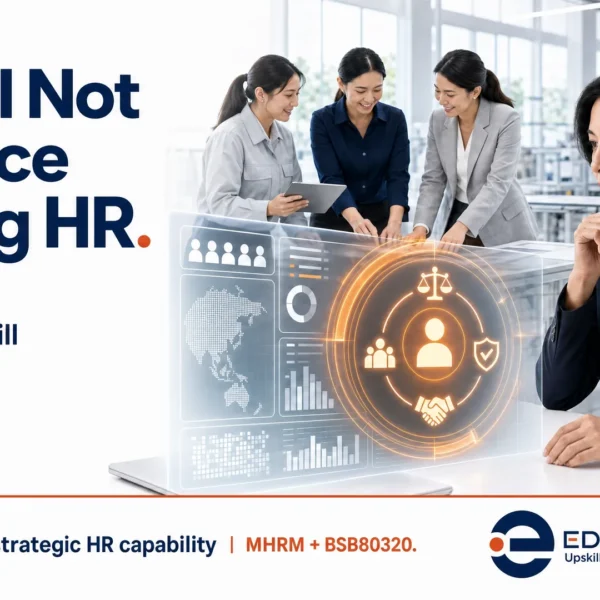

In short: Technology will not make HR strategic. It will only make it harder to justify senior capability spent on work that can be automated. The HR leaders who matter over the next decade will be the ones who can translate workforce capability, cost and risk into enterprise decisions, a skill set most HR careers never deliberately build.
The question is not whether technology will change HR. It is whether HR leaders will help shape the business response.
There is a comfortable story people tell about the future of HR. AI will take the administration. HR will become more strategic. Everyone will be better off. It is a neat story. It is also incomplete.
Technology does not automatically make an HR function strategic. It simply makes it harder to justify spending senior capability on work that can be standardised, automated or supported by better systems. The strategic shift occurs only when HR leaders can leverage the capacity that technology creates to influence the decisions that determine whether the organisation can execute its strategy.
That is a very different job.
The World Economic Forum’s Future of Jobs Report 2025 found that 86% of surveyed employers expect advances in AI and information processing to transform their business by 2030. The point is not that HR will disappear. It will not. The point is that HR’s value proposition is changing.
The HR professional who is known only for process excellence will remain useful. The HR leader who can connect workforce capability, operating risk, financial trade-offs and business strategy will become increasingly difficult to ignore.
That is the shift from HR Manager to Enterprise Leader.
Enterprise leadership in HR is the ability to translate workforce capability, cost and risk into decisions the executive team can act on. It is not a title, and it is not a change of language. It is a different standard of judgement.
Good HR Management Is Not the Problem
Let us be clear: this transition is not an argument against operational HR.
Organisations need people who can recruit effectively, resolve employee relations matters, build credible reward structures, manage performance, design learning initiatives, ensure compliance, and maintain a coherent employee experience. Those disciplines are essential. When they fail, the business feels it immediately.
But being excellent at HR operations is no longer sufficient preparation for senior enterprise leadership.
An enterprise leader is asked a different set of questions:
- Can this organisation deliver the strategy the board has approved with its current capabilities?
- Which critical roles, skills or leadership behaviours could stop the strategy from being executed?
- What is the people risk in this restructure, acquisition, technology investment or new-market decision?
- What should we build internally, buy from the market, redesign or stop doing altogether?
- How do we know that the workforce investment is creating business value, rather than simply activity?
These are not traditional HR questions. They are enterprise questions with a workforce consequence.
And that is precisely why HR must learn to lead them.
The Old Model of HR Is Too Narrow
For too long, HR has been assessed by the efficiency of its function: time to hire, attrition, engagement, training completion, case closure, policy compliance and headcount.
None of those measures is irrelevant. The problem is that they often lack an enterprise narrative. I have written separately about moving from headcount reports to enterprise capability; this article is about the capability an individual leader has to build to make that move.
A monthly attrition figure does not tell the executive team what it needs to know. A strategic people leader asks a more useful question: which capabilities are we losing, from which parts of the organisation, and what does that mean for delivery, customer confidence, operating risk and future growth? Answering that requires the ability to translate workforce data into business decisions, not simply to report it.
A learning-completion rate is not a strategy. A strategic people leader asks: “What capability does the business need in the next 12 to 24 months? Where is the gap, and what is the most credible way to close it?” That is a question about return on training investment, not participation.
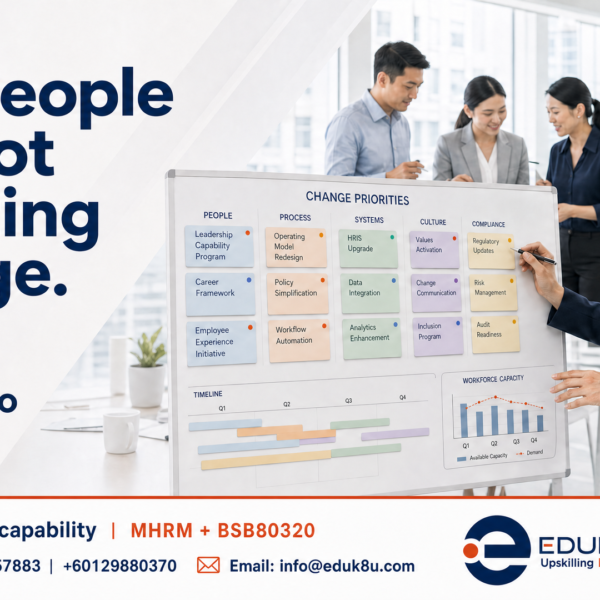
A workforce plan that merely predicts headcount is not a strategic plan. A strategic workforce plan makes explicit the capability, cost, sequencing and risk assumptions behind the business strategy.
This is not semantics. It changes the quality of the conversation.
When HR brings activity metrics, it is invited to report. When HR brings capability insights and business scenarios, it is invited to influence the conversation.
The Capability That Matters Is Translation
The biggest gap I see in many capable HR professionals is not a lack of technical HR knowledge. It is the ability to translate that knowledge into enterprise decisions, which is why connecting HR business partnering to organisational strategy is now a threshold skill rather than an advanced one.
For example, a functional HR response to a proposed restructure may focus on consultation requirements, role impacts, communications, redundancies and implementation timing. All of that matters.
An enterprise leadership response adds another layer:
- What capability will the organisation lose during the transition?
- Which teams are already carrying delivery risk?
- What will the restructure do to customer continuity, operational resilience and the leadership pipeline?
- Which assumptions in the financial case depend on people adapting faster than the organisation has historically done so?
- What alternative sequencing would protect critical capability while still achieving the strategic intent?
That is not HR being obstructive. It is HR doing its job at the level the enterprise needs. It is also why late-stage HR involvement in transformation is so expensive, and why workforce optimisation and restructuring should begin as a capability question rather than a cost question.
The same principle applies to AI adoption. Deloitte’s 2026 Global Human Capital Trends report argues that technology alone does not create value. Value is created when organisations intentionally redesign roles, workflows and decision-making to enable human and machine collaboration.
That is an enterprise leadership challenge. It involves governance, work design, trust, capability, culture and accountability. HR has a material contribution to make, provided it can bring more than a technology policy or a training calendar to the conversation.
Five Questions Every HR Leader Should Be Able to Lead
If you want to know whether you are operating as an HR Manager or moving towards enterprise leadership, examine the questions you are bringing into the room. Gartner reached a similar conclusion in its 2026 research, finding that CHRO priorities now centre on realising AI value and driving performance amid uncertainty rather than on functional efficiency. The same logic underpins an effective HR strategy blueprint.
| Move beyond this question. | Lead with this question instead. |
|---|---|
| How quickly can we fill the vacancies? | Which roles and capabilities are genuinely critical to delivering the strategy, and how will we secure them? |
| What is our engagement score? | Which workforce conditions are helping or obstructing execution in the parts of the business that matter most? |
| How many people have completed the learning programme? | Has the organisation built the capability required to execute its priority commitments? |
| What is our headcount plan? | What workforce shape, capability mix and cost profile does the strategy require, and what risks sit between today and that future state? |
| How do we manage the change process? | What must change in structure, capability, culture and leadership behaviour for this transformation to deliver its intended outcome? |
These questions require stronger commercial judgement. They require comfort with data, finance, risk, operational realities and ambiguity. They also require the confidence to challenge a senior leadership team constructively when workforce capacity does not align with strategic ambition.
Such an undertaking demands considerable work. It should be.
The Regional Context Matters: Malaysia, Singapore and Australia
Across Malaysia, Singapore and Australia, HR leaders are facing different labour markets, regulatory environments and talent pressures. But one challenge is consistent: the pace of business change is putting pressure on organisations to be more adaptive, not just more efficient.
Deloitte’s 2026 research found that seven in ten business leaders name speed and agility as their primary competitive strategy for the next three years. In Australia, Gartner’s 2026 analysis of HR priorities points to the same pressure: workforce redesign in the human-machine era, leadership readiness under uncertainty, and culture as a performance lever. In Singapore, the Institute for Human Resource Professionals has made it clear that the profession’s credibility now rests on business and technology fluency, not administrative competence.
In that environment, a static annual people plan will not be enough. HR leaders need to help organisations continuously reassess capability, workforce capacity, decision rights and the practical consequences of change.
The answer is not to imitate the language of strategy. It is to become fluent in the disciplines that make strategy executable.
That means learning to read a business case as critically as an HR policy. It means understanding financial tradeoffs, not just people’s preferences. It means treating workforce data as a decision input, not a monthly reporting exercise. It means being able to say, respectfully but clearly, “The strategy is sound, but the execution assumptions need work.”
That is influence.
The Career Question Is Not a Title
Many HR professionals say they want to become a Head of HR, an HR Director, or a Chief People Officer. The more useful question is: what capability will the organisation expect from me when I get there?
A title does not create enterprise leadership capability. A promotion does not automatically produce commercial judgement, strategic thinking or the ability to lead through ambiguity. Those capabilities have to be built deliberately, often before the opportunity appears.
For professionals looking to deepen that capability, the BSB80320 Graduate Diploma of Strategic Leadership is an Australian nationally recognised AQF Level 8 postgraduate VET qualification, listed on the national register as BSB80320. It comprises eight units, two core and six electives, covering strategic transformation, strategic planning, collaborative partnerships, business continuity, innovation, ethical practice, financial strategy and critical thinking.
It is not a shortcut to a job title, and it does not guarantee a promotion. It is a structured opportunity to develop and demonstrate strategic leadership capabilities that are relevant to complex organisational environments. That distinction matters. Professionals seeking a broader HR-specific pathway may also consider the Executive Master of Human Resource Management.
Technology alone will not decide the future of HR. It will be decided by whether HR leaders can move beyond managing the function and become credible contributors to how the enterprise adapts, competes and creates value.
The question is not whether you are a good HR manager. The question is whether you are building the capability to become an Enterprise Leader.
Frequently Asked Questions
What is the difference between an HR manager and an enterprise leader? An HR manager is accountable for the performance of the HR function, including recruitment, employee relations, rewards, performance, and compliance. An enterprise leader is accountable for ensuring the organisation has the capability to execute its strategy and for translating workforce capability, cost, and risk into decisions the executive team can act on.
Will AI replace HR jobs? No, but it will change what senior HR capability is worth. The World Economic Forum’s Future of Jobs Report 2025 found 86% of employers expect AI and information processing to transform their business by 2030. Administrative HR work will be automated first; judgement about capability, risk and work design will not.
What skills do HR professionals need to reach the CHRO level? HR professionals need commercial and financial literacy, strategic workforce planning, risk assessment, work and organisation design, data interpretation as a decision input, and the confidence to challenge an executive team when strategic ambition outruns workforce capacity.
Is the BSB80320 Graduate Diploma of Strategic Leadership recognised in Malaysia and Singapore? BSB80320 is an Australian nationally recognised VET qualification at AQF Level 8, listed on training.gov.au and delivered under ASQA regulation. It is internationally recognised by and across Malaysia and Singapore as an Australian postgraduate level credential.
How long does the BSB80320 Graduate Diploma take? The qualification comprises eight units of competency, two core and six electives. Duration varies by provider and study mode; EDUK8U can confirm the current intake schedule and delivery format on request.
Ready to have a different conversation about your HR leadership trajectory?
WhatsApp now: +60129880370 or +61420457883. | https://wa.link/ktq1ok to start the conversation.
#StrategicHR #HRBP #FutureOfWork2026 #PsychosocialSafety #APACBusiness #LeadershipDevelopment #HRStrategy #FutureOfWork2030 #HRLeadership #SingaporeBusiness. #EmployeeWellbeing #HumanCapitalAnalytics #WorkplaceCulture #FairWork #DigitalTransformationHR #LeadershipDevelopment #EDUK8U #workreadyasia #HRCourses #HRData #2026problems #talentattraction #GenAIinHR #HRDataLeadership