
Regional Australia is being squeezed from three directions at once: demand is rising as the population ages, the workforce is leaving faster than it arrives, and metropolitan employers are winning every contested hire. No recruitment campaign fixes a structural squeeze. What changes it is building workforce capability that is Australian governed and locally retained, fed by a properly constructed cross border bridge rather than by opportunistic hiring.
Key takeaways
- In early 2026, regional and rural hospitals accounted for around 70% of Victoria's emergency department stays lasting over 24 hours, despite a departmental target of zero.
- The mechanism is not mysterious. No GP access at the front end, no residential capacity at the back end, and the emergency department absorbs both because it cannot turn anyone away.
- Regional employers lose contested hires to metropolitan employers on almost every variable except for need. Competing harder on the same terms does not work.
- Sovereign workforce capability means Australian employed, Australian qualified, Australian regulated and locally retained capability you govern rather than rent.
- A talent bridge differs from recruitment in one respect that decides everything: obligations run in both directions, and the design horizon is years rather than a vacancy.
1. What the squeeze actually is
Three forces, arriving together.
Demand is climbing and will not stop. The oldest baby boomers began turning 80 in 2026. ABC's reporting notes Australia needs roughly 10,000 additional aged care beds each year and produced around 800 last year. That gap does not close through efficiency.
Formal care is not reaching people in time. Four Corners reported in August 2026 a median wait of around ten months between applying for support and receiving it. In August, the ABC also reported that 50,000 people were removed from the official aged care waitlist through a change in counting method. However that change is interpreted, it does not alter how many people need support.
The overflow lands on the hospital. ABC reported that of roughly 3,300 Victorian patients spending 24 hours or more in an emergency department between January and March 2026, around 2,330, some 70%, were in regional and rural hospitals. The departmental target for that measure is zero. Health workers described the driver in ordinary language: patients facing six week waits to see a GP, and no nursing home places available at the other end.
None of these is a separate problem. They are one problem seen from three positions, and the variable underneath all three is people.
2. Where the squeeze actually bites
The asymmetry is easiest to see side by side. A metropolitan employer draws on a deep pool of local resident candidates. A regional employer draws on a thin one, and usually has to relocate someone. Housing is the metro hire's own problem. In the regions it frequently becomes yours. Agency backfill in the city is available and expensive. In the regions it is expensive and sometimes simply unavailable. Expected tenure in the city is moderate. In the regions it is shorter, because the return path stays open.
And the consequences diverge sharply. A metropolitan vacancy gets redistributed across a roster. A regional vacancy pauses a service line. A metropolitan failure produces poor service. A regional failure produces someone waiting 24 hours in an emergency department corridor.
The asymmetry explains everything. Regional services face the highest consequence of failure and the weakest position to prevent it. That gap does not close by trying harder at recruitment, because recruitment is the activity in which metropolitan employers hold every advantage.
3. Why the funding logic works against you
Here the advocacy is not aimed at any government. It targets what current models reward.
The Victorian government has pointed to record investment and new solutions in the health system, and that investment is real. But funding and reporting cycles across the sector overwhelmingly measure activity: positions filled, programmes started, places funded. Very little measures whether the person filling the position in March is still there in December.
So the sector optimises for what it measures. It counts recruitment. It does not count retention. And a system that funds recruitment will produce recruitment, indefinitely, at rising cost, without ever closing the gap.
The Australian Medical Association has called for a parliamentary inquiry into regional and rural healthcare and for long term planning rather than short cycle responses. That instinct is right, and it applies equally to the workforce. The unit of planning is wrong. Fix the unit, and the behaviour follows.
This is the argument for sovereign capability.
4. What sovereign workforce capability means
The term is borrowed deliberately from industrial policy, where sovereign capability means the ability to build and sustain something domestically rather than depending on volatile external supply. Applied to the care workforce, it has four concrete components, all of which are testable, which is the point.
Australian employed. A single accountable Australian employer of record, licensed and regulated here. Workready Asia holds the Victorian labour hire licence VICLHL07926.
Australian qualified. Certification is delivered to nationally recognised standards under the Australian Qualifications Framework. Not equivalence assessments, not assumed transferability. CHC33021 Certificate III in Individual Support (Ageing and Disability), held alongside the Bachelor of Science in Nursing every participant brings.
Australian regulated. Practice is governed by the strengthened Aged Care Quality Standards and the NDIS Practice Standards, with the evidence to demonstrate it. Attend Care Pty Ltd is a registered NDIS provider (4-K4BR3Q0).
Locally retained. Capability that stays in the community it serves rather than circulating between vacancies.
The distinction from agency supply is not quality. It is control. Agency labour is capacity you rent at market price, with tenure measured in shifts and no local knowledge accumulated. Sovereign capability is the workforce you build, govern and keep, where the person supporting a resident in year three knows what that resident was like in year one.
5. A bridge, not a pipeline
The word "pipeline" is honest about how most international recruitment works. Material enters one end and is delivered at the other. Nobody asks what the material wanted.
A bridge carries traffic both ways, and it is built to a standard because people cross it.
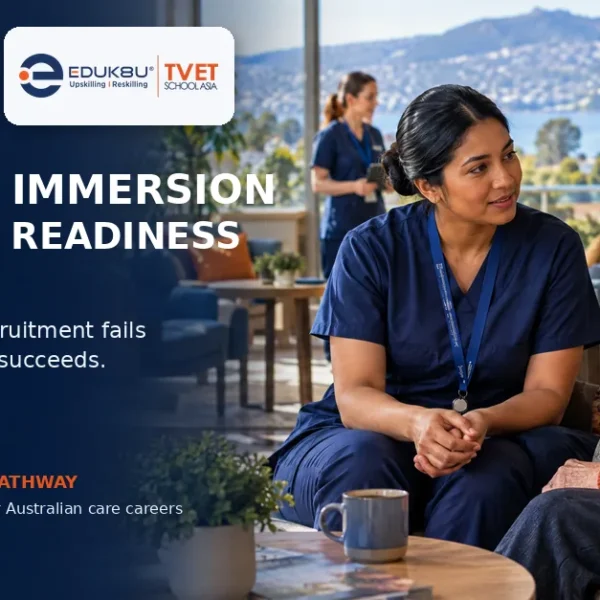
Set the two models against each other and the difference is not subtle. Recruitment plans around the vacancy. A bridge is planned for two to three years. Recruitment prepares people for days. A bridge prepares them through a twelve month performance reviewed immersion. Recruitment assumes an Australian context. A bridge teaches it before its absence costs anyone. Recruitment places people wherever the need is. A bridge places them in one community, deliberately. Recruitment discusses progression. A bridge evidences it, with competency managed and upskilling tracked. Recruitment obligates one party. A bridge obligates both. And they measure success differently. Recruitment counts the position filled. A bridge counts whether the person is still there and better at it.
6. The extraction question, answered directly
There is a real objection to any cross border workforce model, and it deserves a straight answer rather than a slogan: does regional Australia's shortage get solved by drawing skilled graduates out of countries with their own health needs?
Our position is that ethics reside in the structure, not in intention.
A model that treats nursing graduates from Colombo or Manila as supply, moves them between vacancies, checks their credentials only once and leaves their careers unmanaged is extraction. It also fails commercially, because those individuals eventually leave. Within three years, you have paid twice and built nothing.
A model that invests in the person is a different transaction. Twelve months of structured, performance reviewed practice with documented feedback. Progression that rests on an evidenced record rather than on who noticed them. Deliberate retention in one community so the professional accumulates standing rather than mileage. The capability built belongs to the individual permanently, wherever their career eventually goes.
What each side gets should be stated plainly, because a partnership nobody can describe is usually not one.
Regional Australia gains a degree qualified, context prepared workforce that stays long enough to know the residents. For a person living with dementia, continuity is a clinical asset rather than a convenience.
The professional gains entry to Australian practice with the context taught rather than guessed, a permanent documented record of their capability, and a career built over years in one place rather than a sequence of short contracts in unfamiliar towns.
If the second column is empty, the model is extraction with better branding. We would rather be held to that test than to an adjective.
7. Changing the unit of planning
The practical shift for a provider board is small to describe and significant in effect: stop planning in vacancies and start planning in three year blocks. A vacancy filled in March and vacant again in January was never filled; it was postponed at full cost, plus the recruitment expense, and the disruption to residents who had just got used to someone.
Plans are made in three year blocks, and different decisions follow. Preparation becomes worth funding. Retention becomes worth measuring. Continuity becomes something you can promise a family and really mean.
"Regional services aren't losing the recruitment race because they're doing it badly. They're losing because recruitment is the wrong race. You can't out-recruit a structural shortage; you have to build capability and keep it."
Hon. Prof. Dr Roy Prasad, Group MD/CEO
8. The evidence layer
Workforce management, competency and compliance run on Prodigy. Work logged is geospatially tagged. Hours delivered are recorded against work performed. Staff competency is managed in the platform, ongoing upskilling is tracked, and credential currency and relevancy are monitored.
Consistent with the position set out in Article 1: none of that decides anything about a person's care. Every judgement inside a shift stays with the worker. The platform exists so human work can be evidenced, which is what accountability requires and what audit under the strengthened Aged Care Quality Standards and NDIS Practice Standards is actually asking for.
Providers who build the record as work happens experience audit as retrieval, while those who don't experience it as archaeology.
9. Where we operate
Port Macquarie, on the New South Wales Mid North Coast, is live now with 28 participants in the catchment. Coffs Harbour commences next. Across the following eighteen months: Bendigo, Mildura, Tamworth, Griffith, Shoalhaven, Orange, Dubbo, Rockhampton, Bundaberg, Mackay and the Riverina. Sequencing follows demand. If your catchment is not listed and your vacancy profile justifies it, that order is not fixed.
What we can show you and what we can't. Workready Asia engages the workforce. Attend Care Pty Ltd is a registered NDIS provider (4-K4BR3Q0). Workready Asia holds the Victorian labour hire licence VICLHL07926. All certification is delivered to nationally recognised standards under the Australian Qualifications Framework. 28 participants are working in the Port Macquarie catchment, with Coffs Harbour next. We do not name our host employers. Every host agreement carries confidentiality obligations, and the discipline that keeps their name out of our marketing is the same discipline that keeps their incident data, rosters and audit history out of everyone else's. If you are evaluating us, request a verified reference under mutual NDA. We would rather be tested than believed.
Summary
Regional Australia faces a three way workforce squeeze: rising demand as the population ages, formal care not arriving in time, and overflow landing on hospitals, with regional and rural facilities carrying around 70% of Victoria's 24 hour plus emergency department stays in early 2026. Regional employers lose contested hires on every variable except need, and funding models that measure recruitment activity rather than retention entrench the problem. Sovereign workforce capability (Australian employed, Australian qualified under the AQF, Australian regulated and locally retained) is capability providers govern rather than rent. A cross border talent bridge differs from recruitment in that obligations run both ways: twelve months of performance reviewed immersion, deliberate retention in one community, and progression evidenced through managed competency and tracked upskilling. Workready Asia deploys BSc nursing graduates holding CHC33021 as assistants in nursing and disability support workers, with delivery evidenced through Prodigy.
Frequently asked questions
What is sovereign workforce capability in healthcare?
Workforce capability that is Australian, employed under a licensed employer of record, qualified to nationally recognised AQF standards, regulated under the applicable quality standards, and retained locally in the community it serves, as distinct from capacity rented from a spot market.
How is a talent bridge different from international recruitment?
Recruitment is organised around filling vacancies. A bridge is organised around a two to three year horizon with obligations running both ways: structured preparation, deliberate retention in one location, and progression evidenced rather than promised.
Why do regional services lose out on hires?
Thinner candidate pools, housing burdens that fall on the employer, shorter tenure because the metropolitan return path stays open, and a far higher consequence when a position sits empty. The disadvantage is structural, not a failure of effort.
What qualifications do your workers hold?
A Bachelor of Science in Nursing and a CHC33021 Certificate III in Individual Support (Ageing and Disability), both delivered to nationally recognised standards under the Australian Qualifications Framework.
What compliance evidence does a host provider receive?
Geospatially tagged shift logs with hours delivered recorded against work performed, alongside managed competency, tracked upskilling and monitored credential currency.
Which regions do you operate in?
Port Macquarie now, Coffs Harbour next, then Bendigo, Mildura, Tamworth, Griffith, Shoalhaven, Orange, Dubbo, Rockhampton, Bundaberg, Mackay and the Riverina over the following eighteen months.
About Workready Asia
Workready Asia Pty Ltd is the employment arm of the EDUK8U Group, employing and supporting qualified care workers across regional Australia. Certification is delivered to nationally recognised standards under the Australian Qualifications Framework. Workforce management, competency and compliance run on Prodigy. Attend Care Pty Ltd is a registered NDIS provider within the group. Labour hire licence VICLHL07926.
Contact: info@workreadyasia.com | WhatsApp: +61 420 457 883
Topics: aged care reform, regional health, healthcare workforce, nursing in Australia, NDIS, workforce technology and human-centred care.