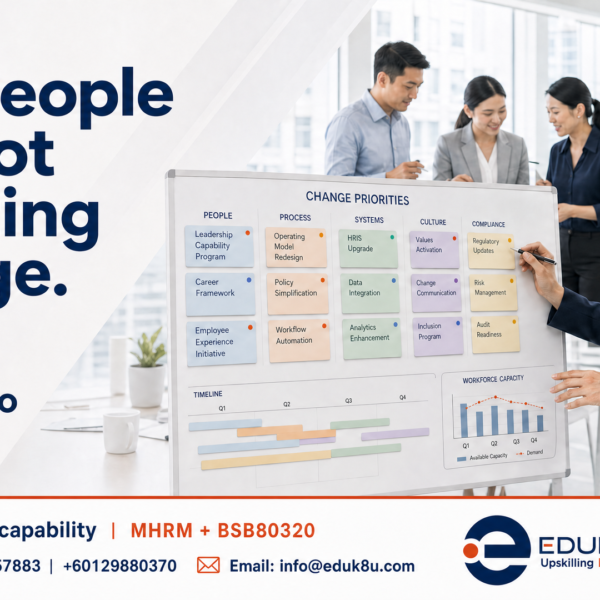

I still hear this sentence too often. “Our people are resistant to change.” Sometimes that is true; however, it is rarely the whole story. In a dynamic environment staff get asked to absorb a new operating model, a system implementation, revised performance measures, tighter budgets, a restructure, new compliance demands and now AI tools. With all of these needing to be done whilst the work or business as usual still gets done.
That is not resistance. That is a cumulative load.
McKinsey reports that the average employee now experiences ten planned change programmes each year, five (5) times the number reported a decade ago. The exact mix will vary by organisation and country; however, the pattern is familiar to HR leaders everywhere. Each initiative makes sense in isolation, and the challenge is that employees do not experience change in isolation.
They experience the total burden.
The issue is not communication. It is prioritisation.
As a change programme starts to struggle, HR is often asked for a communication plan, a manager toolkit and a training schedule.
All useful. None sufficient.
The harder question is this: what are we asking people to stop doing so they have the capacity to do this well? Too often, leadership teams launch change as if organisational energy is unlimited. It is not.
Every new initiative draws on attention, trust, manager time, and employees’ willingness to make another adjustment. If leadership does not actively manage that portfolio, it should not be surprised when the next announcement lands with silence rather than energy.
The CIPD’s 2026 change-management guidance rightly highlights change fatigue and overlapping change as challenges facing people professionals. This is no longer a soft issue. It is an execution issue.
HR needs to change the question.
The old question is, “How do we get people to support this change?” The proactive approach is: “Have we designed this change in a way that people can realistically absorb?” That change in language matters. It moves HR from managing employee reaction to challenging leadership decision making. Before launching another programme, ask yourself these five questions:
- What business outcome will this change deliver? Not activity. Not implementation. What will be measurably different?
- What will be stopped, paused or deferred? If the answer is nothing, the organisation is adding work, not creating capacity.
- What has this team already been through? Look at the past twelve months through the employee’s eyes, not the project plan.
- What must line managers now do differently? Then ask whether they have the time, clarity and support to do it.
- What are employees allowed to challenge or shape? People can tell the difference between genuine involvement and a consultation exercise after the decision is fixed.
Not more town halls. Not another set of slides. A clear decision about the change burden we are placing on people.
Change has to become part of normal work.
Gartner argues that leaders should routinise change rather than rely on inspiration, which is an important distinction. Inspiration is useful at the beginning, helping people understand the ambition. Routine is what carries the organisation through the difficult middle, when enthusiasm has faded, and the practical work begins.
This is where manager capability becomes critical. Managers must be able to explain what is changing, what is not changing, what is expected now, and what can wait. They also need permission to surface concerns upward when a team has reached capacity.
HR cannot do this work for every manager; however, HR must make it visible, measurable and non negotiable.
The strategic HR role is to protect the organisation’s capacity to change
A strong HR leader does not become the internal marketing department for every initiative. They help leadership distinguish between what is urgent, what is important and what is simply fashionable. Asking whether the organisation has earned the right to launch the next change, in turn making the people cost visible before the operational cost becomes unavoidable.
That is not slowing transformation down. That is giving transformation a realistic chance of succeeding.
For HR professionals who want to build greater confidence in strategic planning, transformation and enterprise-level workforce conversations, the combined Executive Master of Human Resource Management and BSB80320 Graduate Diploma of Strategic Leadership pathway is one development option worth exploring.
But before the next change programme is announced, ask yourself this one question first:
What will we stop asking people to carry?
If you are serious about building stronger strategic HR capability, speak to EDUK8U. Start the conversation on WhatsApp.
WhatsApp now: +60129880370 or +61420457883.
#StrategicHR #HRBP #FutureOfWork2026 #PsychosocialSafety #APACBusiness #LeadershipDevelopment #HRStrategy #FutureOfWork2030 #HRLeadership #PsychosocialSafety #SingaporeBusiness. #EmployeeWellbeing #HumanCapitalAnalytics #HRBP #WorkplaceCulture #FairWork #DigitalTransformationHR #EDUK8U #workreadyasia #HRCourses #HRData #2026problems #talentattraction #GenAIinHR #HRDataLeadership