
“We are going through a transformation.”
I hear that sentence in executive meetings. Sometimes it is accurate; however, a transformation that leaves the scorecard untouched is a change programme with a bigger budget. The difference is not size. It is not the number of workstreams or the consultants on site.
A change programme changes how the work is done. A transformation changes what the organisation rewards.
The test is what managers are measured, paid and promoted for.
Twelve months after the announcement, examine four levers:
- What managers are measured on.
- What earns a bonus.
- Who gets promoted, and why.
- Who is allowed to make which decisions without escalating them.
If those four levers are the same as they were before, the organisation has not transformed. It has reorganised. The old organisation is still running underneath the new reporting lines.
A reward system that pays for the old behaviour will keep getting it.
In 1975, Steven Kerr set out this problem in On the folly of rewarding A, while hoping for B, a paper the Academy of Management later republished as one of its classics. The title states the argument: an organisation that rewards one behaviour while hoping for another will get the behaviour it rewards.
A transformation can repeat that folly at scale. Consider a board that approves a customer-centred operating model while its regional managers still measure themselves by cost per transaction. On a busy Tuesday, the measure wins.
McKinsey research found that fewer than one third of organisational transformations succeed in improving performance and sustaining those gains. Sustaining is the hard word in that sentence. My argument is that one reason gains fade is that the system around the workforce still rewards the old behaviour.
These are HR’s levers, and that is the opportunity.
In July I set out six stages of strategic transformation. This article concerns the sixth, embedding and sustaining, and the mechanism underneath it.
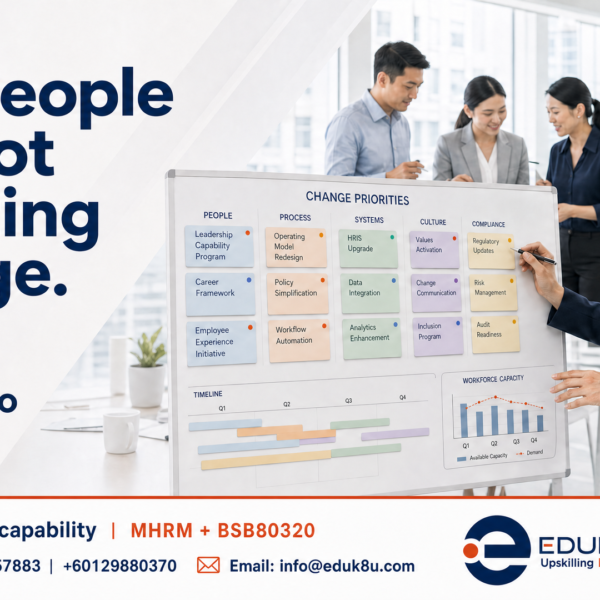
Look at the four levers again. Performance measures. Reward. Promotion criteria. Decision rights. Each one sits wholly or partly with HR. That means the HR leader is not the support act in a transformation. The HR leader holds the levers that decide whether it sticks.
When HR is asked only for a communication plan and a training schedule, the scorecard is left for the next annual cycle. By then, the old behaviour has been paid for twelve more times.
This is what it sounds like in the executive meeting.
Picture the steering committee three months into a transformation. The milestones are green. The CEO asks why the new model is not showing up in the results. The HR leader answers:
“Because nothing we pay for has changed. Our regional managers are still measured on cost per transaction and promoted for hitting it. The new model asks them to spend more time with customers. I am proposing we change three measures in next quarter’s scorecard, and here is what that does to the bonus pool.”
That is not a training request. It is a transformation decision. The HR leader who can make it is the one leading the transformation.
Run the scorecard audit before your next steering committee.
- Write down, in one sentence, the behaviour the transformation needs from managers. Not the outcome. The behaviour.
- Pull the current scorecard for those managers. Mark which measures reward the new behaviour, which are neutral, and which still reward the old one.
- Do the same for the bonus plan and the last round of promotions. Who was promoted, and for what?
- List the decisions the new model needs made locally, and check who is actually allowed to make them.
- Take the gaps to the executive with a costed proposal for the next cycle, not a comment about culture.
The fifth step is the one that changes how an executive team sees its HR leader. A list of misalignments is an observation. A costed change to the scorecard is a decision the executive can act on.
This capability separates HR managers from enterprise leaders.
I have written about HR leaders who think in capability rather than headcount, and about data that changes a decision rather than reports one. Transformation is where the two meet. Among our alumni, the HR leaders I have seen move into Chief People Officer roles could show the board that the strategy and the scorecard were pulling in the same direction and fix it when they were not.
This is the substance of BSBLDR811 Lead Strategic Transformation, a core unit of the BSB80320 Graduate Diploma of Strategic Leadership. It opens a series I am publishing through October on the BSB80320 capabilities that move HR leaders into enterprise roles. Next: strategic planning, and the one page I would ask an HR leader to bring to the next planning offsite.
Twelve months into your last transformation, has the scorecard changed, or only the org chart?
If you are serious about leading transformation rather than supporting it, our Executive Master of HRM with the BSB80320 Graduate Diploma is one development pathway to consider. Leaders outside HR can start with the BSB80320 Graduate Diploma of Strategic Leadership. Speak to EDUK8U. Start the conversation on WhatsApp: AU +61 420 457 883 | MY +60 12 988 0370.
#StrategicHR #HRLeadership #StrategicTransformation #ChiefPeopleOfficer #HRBP #HRStrategy #PerformanceManagement #RewardStrategy #OrganisationalDesign #ChangeLeadership #LeadershipDevelopment #ExecutiveEducation #GraduateDiploma #BSB80320 #FutureOfWork2026 #APACBusiness #AustraliaHR #MalaysiaHR #SingaporeHR #EDUK8U #PsychosocialSafety #FutureOfWork2030 #SingaporeBusiness #EmployeeWellbeing #WorkplaceCulture #NOCN